Phuket Temples: 7 Must-Visit Temples on the Island
Phuket is more than just beaches and parties. After four-plus years of living here, I've realized that the island's temples are the soul of Phuket, its true culture. There are over 40 Buddhist and Chinese temples on the island, but seven of them are absolute must-visits. In this article, I'll tell you about each one: history, what to see, practical details, and my personal impressions.
1. Wat Chalong -- Phuket's Main Temple
Wat Chalong is the most revered temple on the island and the first place I take all my guests. Its full name is Wat Chaiyathararam, but everyone simply says "Chalong." The temple complex is located in the central part of Phuket, in the Chalong area, and is the spiritual heart of the island.
History. The temple was founded in the early 19th century, but it gained its main fame through two monks -- Luang Pho Cham and Luang Pho Chuang. In 1876, when a Chinese miners' uprising broke out in Phuket, these monks helped resolve the conflict peacefully and treated the wounded. Thai people still worship their wax figures in the main hall.
What to see. The main pagoda (Phra Mahathat Chedi), 60 meters tall, is a three-story stupa housing a fragment of Buddha's bone. Inside are murals depicting the story of Buddha's life. The upper floor has an observation deck overlooking the surroundings. Be sure to visit the hall with the monks' wax figures -- the atmosphere is incredible, with Thai people bringing gold leaf and lotus flowers.
Practical details. Opening hours: 7:00-17:00, daily. Admission is free. Dress code: covered shoulders and knees (wraps provided at the entrance). How to get there: the temple is 8 km from Phuket Town, easiest by scooter or taxi (200-300 baht from Patong).
2. Big Buddha (Phra Phutthamingmongkhol Akenakkhiri)
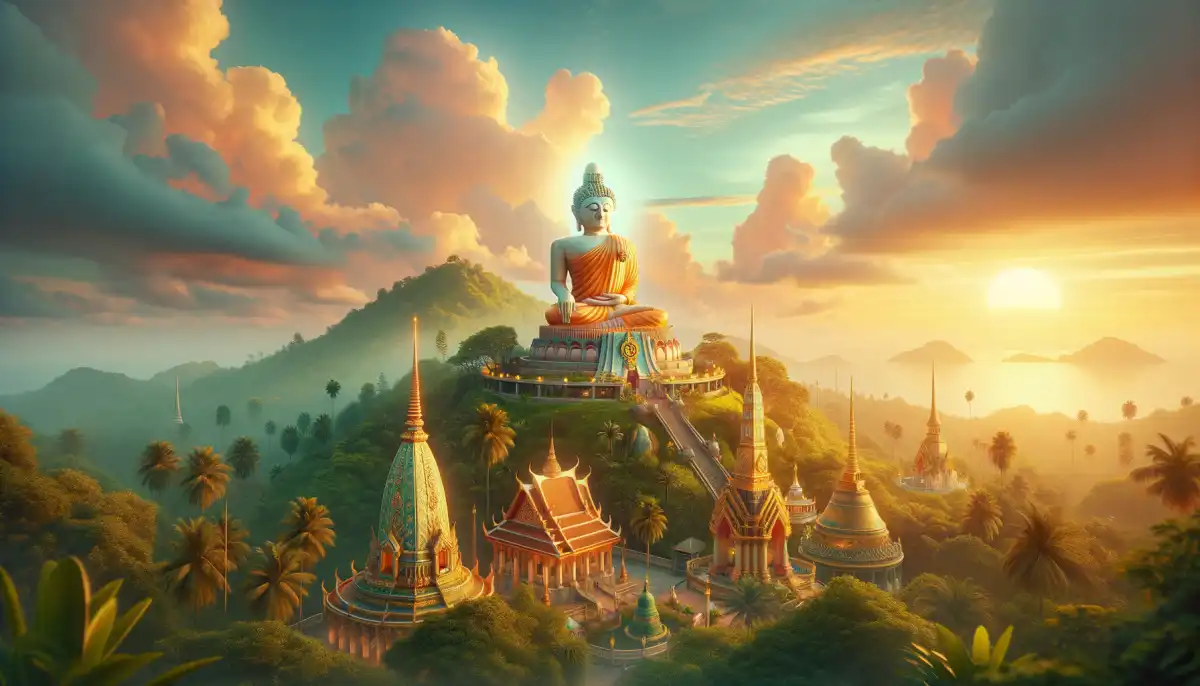
The 45-meter white marble Buddha statue atop Nakkerd Hill is arguably Phuket's most recognizable landmark. It's visible from virtually any point in the southern part of the island, and every time I look up and see the white silhouette against the sky, I feel a certain sense of tranquility.
History. Construction began in 2002 and is still ongoing -- funded entirely by donations. The statue is covered in white Burmese marble and is visible from dozens of kilometers away. Nearby stands a smaller golden Buddha statue, 12 meters tall.
What to see. Beyond the statue itself, the main treasure is the 360-degree panoramic view. From here you can see Chalong Bay, Phang Nga Bay, the Phi Phi Islands on clear days, Kathu, Rawai, and Kata. There are bells on the platform -- ring them for good luck. Inside the base of the statue is a small museum and meditation hall.
Practical details. Opening hours: 6:00-19:00, daily. Admission is free. Strict dress code -- sarongs provided. How to get there: winding road from Chalong Circle, 6 km uphill. The road is narrow, so be careful on a scooter. Free parking. My advice: arrive at 7 AM or 5 PM, when there are no tour buses and the light is perfect for photos.
3. Wat Phra Thong -- Temple of the Golden Buddha
This temple in the Thalang district holds one of Phuket's most enigmatic legends. Here you'll find a half-buried Buddha statue that protrudes from the ground up to its waist. Many have tried to dig it up -- none have succeeded.
History. According to legend, a boy tied his buffalo to a post sticking out of the ground. The buffalo fell ill and died, and the post turned out to be the top of a golden Buddha statue. When locals tried to dig it out, they were attacked by a swarm of wasps. Burmese invaders in the 18th century also tried -- and also failed. The statue remains half-buried, covered in gold leaf.
What to see. The half-buried statue in the main hall is an unusual and impressive sight. Next to it is a small museum with artifacts from Phuket's history and old photographs. The temple grounds are quiet, without tourist crowds -- mostly locals come here to pray.
Practical details. Opening hours: 8:00-17:30, daily. Admission is free. Located on Highway 4027 in Thalang, 20 minutes from the airport. A convenient stop on your way from the north of the island.
Need help planning your trip?
Excursions, transfers, scooter and car rental, real estate -- we'll help with everything. Write to us and we'll reply within 5 minutes.
Message us4. Jui Tui Shrine -- Heart of the Vegetarian Festival
This Chinese Taoist temple in the center of Phuket Town is the epicenter of the famous Vegetarian Festival held every October. If you've been to Phuket during this time, you've surely seen the processions with pierced cheeks and fire-walking -- it all starts right here.
History. The shrine was founded in 1911 by Hokkien Chinese who migrated to Phuket to work in the tin mines. It is dedicated to the Taoist deity Kiu Ong Ia. During the Vegetarian Festival, the main processions of spirit mediums (mah song) depart from here, entering trances and performing rituals of self-mortification.
What to see. The vibrant red-and-gold facade with dragons, incense burners, and altars with fruit offerings. Inside are statues of Chinese deities, carved wooden panels, and paper lanterns. The atmosphere is completely different from Buddhist temples -- more mystical, rich with the scents of sandalwood and frankincense.
Practical details. Opening hours: 8:00-17:30, daily. Admission is free. Located on Ranong Road in Phuket Town, within walking distance of the Old Town. The dress code is more relaxed than at Buddhist temples, but short shorts are best avoided.
5. Put Jaw Shrine -- The Oldest Chinese Temple
Located literally across the street from Jui Tui, but the atmosphere here is different -- more intimate and peaceful. This is Phuket's oldest Chinese temple, founded in the late 18th century.
History. The shrine is dedicated to the goddess of mercy Guan Yin (Kuan Im). According to legend, during an epidemic on Phuket, a troupe of Chinese opera performers began a ritual purification -- nine days of vegetarian diet and prayers. The epidemic retreated, and thus the Vegetarian Festival was born. Put Jaw is considered its birthplace.
What to see. Ancient altars, red paper lanterns, wooden panels carved with Chinese mythological scenes. At the back of the temple is a quiet courtyard with incense burners where you can sit in silence. I love to come here in the morning, when the caretakers light the first incense -- the fragrance carries down the entire street.
Practical details. Opening hours: 8:00-17:00, daily. Admission is free. Address: Soi Phuthon, Phuket Town. I recommend combining it with a walk through the Old Town -- both shrines, street art, and shophouses in one route.
6. Karon Temple (Wat Suwan Khiri Khet)
A small but very photogenic temple right on the main road of Karon Beach. Most tourists drive past without stopping -- and they're missing out. This is one of Phuket's most "alive" temples, where Thai everyday life intertwines with spiritual practice.
History. The temple was built over 100 years ago and serves as the community center for the Karon district. Local festivals, house blessings, and ceremonies for fishermen heading out to sea are held here. On Tuesdays and Saturdays, a market takes place on the temple grounds -- one of the best on Phuket.
What to see. Bright mosaic facade decorations, statues of mythical creatures (nagas, garudas), a well-kept garden with bodhi trees. Inside the main hall are beautiful murals with scenes from Buddha's life. On Tuesdays and Saturdays from 16:00 to 21:00 -- the famous Karon Temple Market with street food, clothing, and souvenirs.
Practical details. Opening hours: dawn to dusk. Admission is free. Located on Patak Road, between Karon and Kata beaches. Standard dress code. I recommend visiting on a Tuesday or Saturday evening -- combine the temple with the market.
7. Wat Phra Nang Sang -- Phuket's Oldest Temple
The oldest temple on the island, founded -- according to legend -- during the Ayutthaya era (14th-15th centuries). Located in Thalang, the historical center of Phuket. Almost no tourists make it here, and that's its greatest advantage.
History. The temple is linked to the legend of a queen who built it to celebrate her rescue from a shipwreck. It houses three tin Buddha statues -- unique in Thailand, since statues are usually made of bronze or gold. The tin is a reminder of Phuket's main industry -- tin mining.
What to see. Three tin Buddha statues in the main hall -- you won't see anything like this elsewhere in Thailand. Ancient wall paintings being restored but retaining their original character. Quiet grounds with ancient trees -- an ideal place for meditation and reflection.
Practical details. Opening hours: 8:00-17:00, daily. Admission is free. Located in Thalang, 5 minutes from the Heroines Monument. Convenient to combine with a visit to the Thalang Museum and Wat Phra Thong.
General Rules for Visiting Temples in Phuket
Dress code. Covered shoulders and knees are mandatory at all Buddhist temples. Major temples provide wraps, but I always carry a light shawl with me -- more convenient. Shoes are removed before entering any hall.
Behavior. Don't point your feet at Buddha statues, don't turn your back to them for selfies, and don't sit higher than monks. Photography is allowed almost everywhere, but ask permission if in doubt.
Donations. Admission to all temples is free, but donations are welcomed. There's usually a box at the entrance -- 20-100 baht is appropriate. For 20 baht you can buy an offering set: lotus flowers, candles, and incense.
Best time. Early morning (7:00-9:00) -- temples are empty, light is soft, monks are praying. Avoid midday -- the heat is unbearable, and many inner halls close for a break.
Temple Routes in Phuket
Route 1: South (half day). Wat Chalong (morning, 1-1.5 hours) -- Big Buddha (30-minute drive, 1-2 hours up top) -- lunch in Chalong. This is the most popular combination, and for good reason -- two major temples close to each other.
Route 2: Phuket Town (half day). Jui Tui -- Put Jaw (across the street from each other) -- Old Town stroll -- lunch in a shophouse. Perfectly combined with viewing street art and Sino-Portuguese architecture.
Route 3: North (half day). Wat Phra Thong -- Wat Phra Nang Sang -- Thalang Museum -- Heroines Monument. This route is for those who want a deeper understanding of Phuket's history.
If you'd like to see the temples as part of an organized excursion, that's also possible -- island overview tours usually include Wat Chalong and Big Buddha. But I recommend going independently by scooter: stop wherever you want, spend as much time as you need.