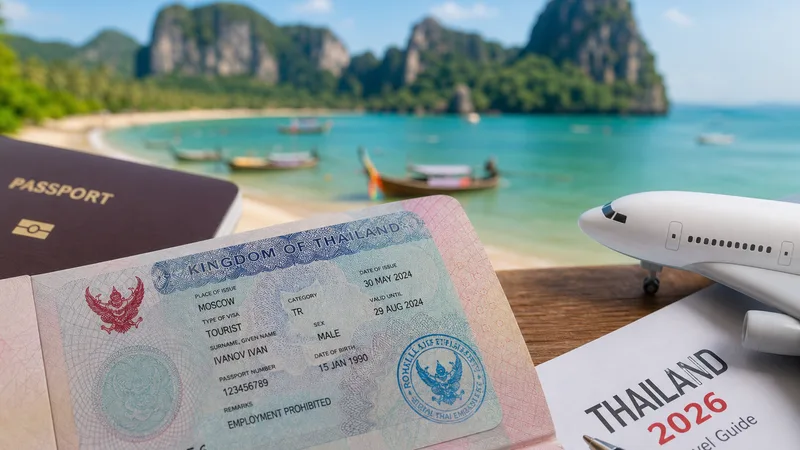
Thailand's visa rules were updated in 2024 — the visa-free period was extended from 30 to 60 days for many nationalities, including citizens of Russia, the EU, the UK, the US, Australia, and dozens of other countries. This format remains in effect in 2026. I have been living in Phuket for over four years and have gone through every type of visa — from visa exemption to DTV. Here is a detailed guide on what works and what to watch out for.
Visa-Free Entry — 60 Days at No Cost
Citizens of eligible countries receive a Visa Exemption stamp for 60 days upon arrival. All you need is a passport valid for at least 6 months. There is nothing to arrange in advance — the stamp is free and issued at the airport. This rule has been in effect since June 2024 and has been extended indefinitely. The full list of eligible nationalities is published on the Thai Immigration Bureau website.
Watch the video overview on our YouTube channel
At passport control, you may be asked to show:
- A return ticket (or a ticket to a third country)
- Hotel booking or proof of accommodation
- Proof of funds (20,000 THB in cash or equivalent on a card) — rarely checked in practice, but officially required
In four years of living here, I have never been asked to show money. But I was asked for a return ticket twice — it is best to have at least a refundable booking. If you have just arrived and are wondering how to get from Phuket Airport — I have a separate article covering all the options.
Source: Immigration Bureau of Thailand, Notification No. 327/2567 (2024)
Extending Your Visa-Free Stay by 30 Days
About 7 to 10 days before your 60-day stamp expires, you can apply for an Extension of Stay at the local immigration office. In Phuket, this is the Phuket Immigration Office, located in the computing center building in Phuket Town (Soi Phutorn). Office hours: 08:30–12:00 and 13:00–16:30, Monday to Friday. Closed on weekends and Thai public holidays.
Documents required for the extension:
- Passport (original) + photocopy of the photo page and entry stamp
- One passport photo (4x6 cm, recent, white background)
- Completed TM.7 form (available at the office or downloadable in advance)
- Copy of TM.30 (notification of residence — usually filed by your hotel or landlord)
- Fee — 1,900 THB in cash
Arrive in the morning when the office opens at 08:30 — queues can be long, especially during high season (November to March). The process typically takes 2 to 4 hours. Bring a pen, a bottle of water, and a charged phone — the waiting area is air-conditioned, but it can be boring.
Tip: make your photocopies in advance. There is a copy shop near immigration, but prices are inflated and there is a separate queue.
Total: 60 + 30 = 90 days maximum on a visa-free stay. This is enough for a long vacation or a winter escape.
Visa Types at a Glance
| Visa Type | Duration | Cost | Best For |
|---|---|---|---|
| Visa Exemption | 60 days + 30 extension | Free + 1,900 THB | Tourists, short stays |
| Tourist Visa (TR) | 60 days + 30 extension | 2,000 THB (~$55) | Guaranteed entry |
| STV (Special Tourist Visa) | 90 days, multiple entry | 2,000 THB | Long-term tourism |
| Education Visa (ED) | Up to 1 year | From 5,000 THB | Language/Muay Thai courses |
| DTV (Digital Nomad Visa) | 180 days, multiple entry for 5 years | 10,000 THB | Freelancers, remote workers |
| Elite Visa | 5–20 years | 600,000–2,000,000 THB | Investors, high-net-worth individuals |
Sources: Royal Thai Embassy, Thailand Privilege Card (Elite Visa), BOI Thailand. Prices current as of May 2026.
Below is a detailed breakdown of each visa type.
Tourist Visa (TR) — 60 + 30 Days
The Tourist Visa essentially gives you the same duration as visa-free entry: 60 days with the option to extend for 30 more. The difference is that you apply for it in advance at a Thai consulate, which means you are guaranteed entry with no questions at passport control. The cost is approximately 2,000 THB ($55). Applications can be submitted at a Thai consulate or through the E-Visa system online.
This is worth considering if you are flying one-way and do not want to buy a return ticket just for show. It also helps if your passport has many Thai entry stamps — immigration officers sometimes ask questions when they see frequent visa-free entries.
STV — Special Tourist Visa
The STV (Special Tourist Visa) was introduced during the COVID era to attract long-term tourists. It grants 90 days of stay with the option of two 90-day extensions (up to 270 days total). The cost is 2,000 THB. Multiple entry allows you to leave and return without losing your status.
In practice, few people apply for the STV — the DTV visa is simpler and more cost-effective for long stays. But if you are not working remotely and simply want to spend the winter in Thailand, the STV remains a viable option.
DTV — Digital Nomad Visa
The Digital Nomad Visa (DTV) is a visa type launched in 2024. It is the best option for freelancers, remote workers, bloggers, and entrepreneurs who work online. The cost is 10,000 THB (~$280). It grants 180 days of stay with multiple entry, and the visa itself is valid for 5 years.
Documents required for DTV:
- Passport valid for at least 6 months
- Passport photo (4x6 cm)
- Proof of income — at least $1,500/month (bank statements for 3–6 months)
- Proof of remote work: employment contract, freelance documentation, screenshots from platforms (Upwork, Fiverr, etc.)
- Bank statement showing a balance of at least $10,000 (recommended)
You can apply at a Thai consulate or through the E-Visa system online. I applied through a consulate — the process took about 5 business days. Every 180 days, you need to leave and re-enter the country (or extend locally for another 10,000 THB).
DTV is my personal choice for long-term living. No language school enrollment required, no need to invest millions in an Elite visa — just prove your income and keep working.
ED Visa — Education Visa
The Education Visa (ED) is issued for the duration of your studies — usually up to 1 year. It is suitable for studying Thai language, Muay Thai, cooking courses, or yoga. The visa fee starts at 5,000 THB, plus tuition fees (from 15,000 to 50,000 THB depending on the school).
There are several schools in Phuket accredited to sponsor ED visas. Every 90 days, you must file a 90-day report at immigration (this can be done online). It is important to actually attend your classes — immigration occasionally conducts inspections, and if they find you are not studying, your visa will be revoked.
Elite Visa — For Those Ready to Invest
The Thailand Privilege Card (formerly Elite Visa) is a long-term visa for 5, 10, or 20 years. The minimum cost is 600,000 THB (~$17,000) for the 5-year package. The top-tier 20-year package with VIP privileges costs 2,000,000 THB.
What the Elite Visa offers:
- Multiple entry for the entire validity period
- Fast-track through passport control (dedicated counter)
- Airport meet-and-greet with a personal assistant
- Assistance with 90-day reports and other paperwork
If you plan to live in Thailand long-term and have the budget, Elite eliminates all visa hassles. No extensions, no border runs, no document gathering every six months.
Overstay Penalties
Staying beyond your permitted period is a violation that Thailand takes seriously. Here is what you face:
- 500 THB per day of overstay, up to a maximum of 20,000 THB
- Overstay up to 90 days — fine upon departure, no entry ban (if you turn yourself in)
- Over 90 days — 1-year entry ban
- Over 1 year — 3-year entry ban
- Over 3 years — 5-year entry ban
- Over 5 years — 10-year entry ban
- If you are caught by police while on overstay (rather than voluntarily departing) — immediate 5-year ban, regardless of duration
The fine is paid at the airport upon departure in cash (Thai baht). Do not risk it — even a single day of overstay is recorded in the system and can cause problems on your next entry.
Border Runs: Exit and Re-Entry
If your stay is about to expire and you cannot extend your visa, you can do a border run (visa run): leave Thailand for a neighboring country and return immediately to get a fresh 60-day stamp.
Popular routes from Phuket:
- Malaysia via Sadao / Dannok checkpoint — the most popular overland route. Bus tours depart early in the morning, and the whole process takes a full day. Tour cost: 2,500 to 4,000 THB depending on the operator
- Penang, Malaysia — combine a border run with a short trip. Flight or bus + ferry. Penang also has a Thai consulate — one of the closest to Phuket — if you need to apply for a visa in advance
- Kuala Lumpur — cheap flights on AirAsia, convenient if you want to spend a couple of days in another country
- Langkawi, Malaysia — ferry from Satun, a quick and scenic route
Important: if you do frequent border runs (3+ times in a row), immigration may start asking questions. Officially, there is no limit on the number of visa-free entries, but in practice an officer can refuse entry if they suspect you are living in Thailand permanently without the appropriate visa. I recommend alternating between land and air entries and keeping proof of income or onward travel handy.
Insurance — Do You Need It?
Officially, Thailand does not require medical insurance for entry (the COVID-era requirement has been lifted). However, I strongly recommend getting coverage — healthcare in Thailand is excellent but expensive. A single visit to Bangkok Hospital Phuket can cost 50,000+ THB, and a serious procedure can run into hundreds of thousands.
Minimum recommended coverage: $50,000. You can purchase a policy online in 5 minutes through providers like SafetyWing, World Nomads, or Allianz Travel. If you plan to rent a motorbike — make sure your policy covers motorcycle accidents. More on licenses and vehicle rental in the article about driving licenses.
What to Bring to the Airport
- Passport (valid for at least 6 months)
- Return ticket or ticket to a third country
- Hotel booking (on your phone or printed)
- 20,000 THB in cash or equivalent (just in case)
- Travel insurance (recommended)
- Printed visa if you applied in advance (TR, DTV, STV)
For more on airport transfers, see the article on how to get from Phuket Airport.
Frequently Asked Questions
Can you extend the visa-free stay twice? No, the extension is granted only once — for 30 days. After 90 days, you must either leave or hold a different visa type.
Can you work on a visa-free stay or tourist visa? No. Any work in Thailand (including freelancing for Thai companies) requires a Work Permit. The DTV visa allows remote work for foreign companies, but not for Thai ones.
What is TM.30? This is a notification of a foreigner's place of residence. Hotels file it automatically. If you are renting an apartment or house, ask your landlord to submit the TM.30 through the app or at immigration.go.th. Without a TM.30, you cannot extend your visa.
What if your passport is expiring? You can renew your passport at your country's embassy or consulate in Thailand. For most nationalities, embassies are located in Bangkok, though some countries maintain honorary consulates in Phuket. Processing times vary — typically 2 to 6 weeks.
Related Articles
- How to Get from Phuket Airport
- Driving Licenses in Thailand
- Best Beaches in Phuket — Top 12
- 5 Common Tourist Mistakes in Phuket
- Phuket Weather by Month
Questions about visas? Message me on Telegram @mitya_phuket_chat — happy to help.
Read Also
- TDAC Form Guide — digital arrival card step-by-step
- Safety in Phuket — laws, insurance, police
- Money & Budget — costs, ATMs, exchange
- From Phuket Airport — arrival guide
- Weather by Month — plan your stay dates
- Wintering in Phuket — long-stay visa options