Motorbike Rental in Phuket 2026: Prices, Rules & Hidden Pitfalls
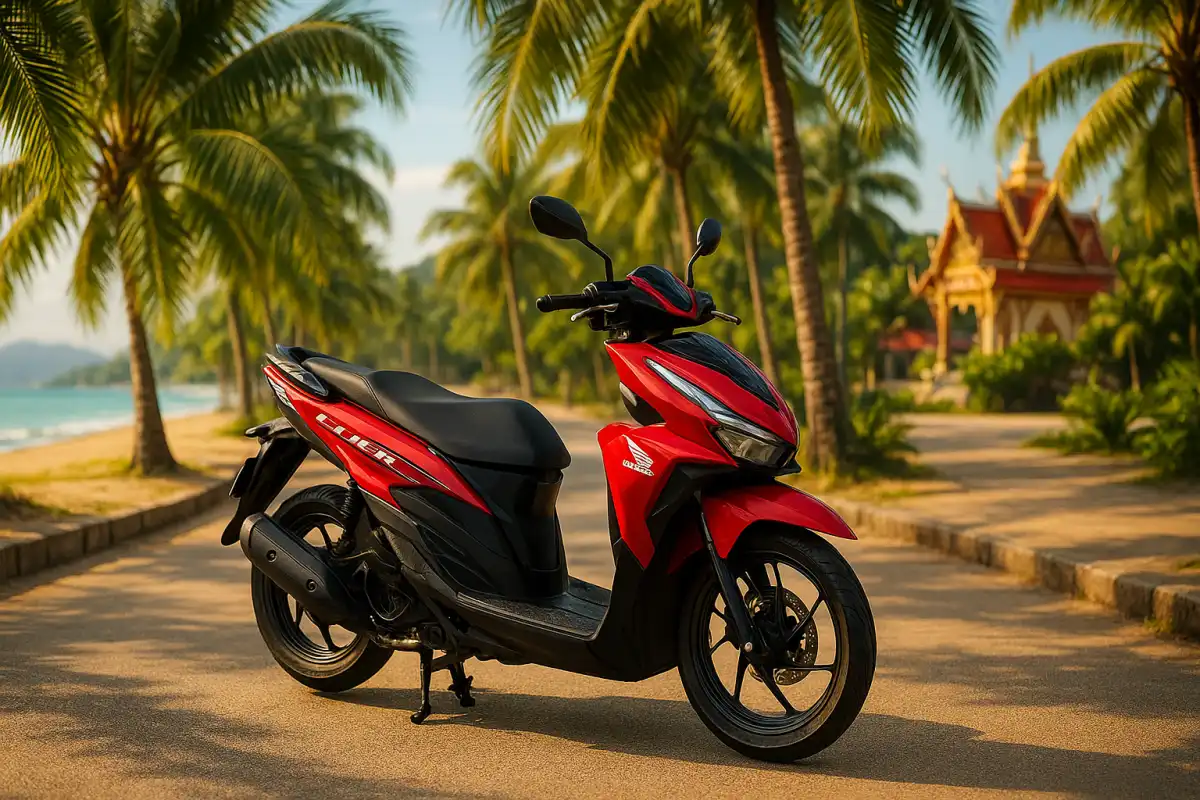
A motorbike is the main mode of transport in Phuket. Public transit is virtually nonexistent, taxis are expensive, and distances between beaches and attractions are significant. So sooner or later almost every tourist thinks about renting a bike. After living on the island for several years, I've rented dozens of different scooters and made every possible mistake. Here's how to do it right and avoid losing money.
Motorbike rental prices in 2026
Prices depend on the model, rental period, and location. During high season (November-March) everything costs 20-30% more. Here are current prices for 2026.
| Model | Per day (THB) | Per month (THB) | Per month (USD) |
|---|---|---|---|
| Honda Click 125 | 200-300 | 3,000-4,000 | $85-$115 |
| Honda PCX 160 | 300-400 | 4,000-5,500 | $115-$155 |
| Yamaha Nmax 155 | 350-500 | 5,000-6,000 | $140-$170 |
| Honda Forza 350 | 600-800 | 8,000-10,000 | $225-$280 |
| Kawasaki Ninja 400 | 800-1,200 | 12,000-18,000 | $340-$510 |
For most tourists, the Honda Click 125 is the perfect choice. Light, fuel-efficient, easy to handle. If you're riding with a passenger or want more comfort -- go with the PCX or Nmax. Bigger bikes only make sense if you have serious riding experience.
Tip: when renting for a month or longer, always negotiate. The real price is usually 500-1,000 THB lower than the initial quote.
Where to rent a motorbike in Phuket
Rental shops
The simplest option -- rental shops on every corner, especially in tourist areas (Patong, Karon, Kata, Rawai). Pros: quick, convenient, can return anytime. Cons: higher prices, bikes are often not in the best shape, and they may try to scam you for "damage" on return.
Private owners
Private owners rent out bikes cheaper and usually maintain them better. Find them through Facebook groups: "Phuket Motorbike Rental," "Phuket Buy & Sell," "Phuket Expats." The downside -- no office and sometimes no backup bike if yours breaks down.
Facebook groups
The best option for long-term rental. You can find bikes at below-market prices, read reviews, and arrange delivery. But be careful: scammers do exist. Check the seller's profile, read reviews, and don't transfer money in advance.
Documents: IDP, Thai license, and fines
This is probably the most important section. Most tourists ride without a license and don't understand the consequences. More on getting a license on our driving license page.
What you need to ride legally:
- International Driving Permit (IDP) with category A (motorcycle). Your regular domestic license does NOT work in Thailand. An IDP can be obtained in your home country and typically costs $15-20
- Or a Thai driving license. Can be obtained in Phuket in 1-2 days, costs about 500 THB. You'll need your passport, a photo, a medical certificate, and a traffic rules test
What happens without a license:
- Fine at a police checkpoint -- 500 THB (about $14). Sounds small, but that's not the main problem
- Your insurance will NOT cover you without a license. Get into an accident and all medical and repair costs come out of your pocket. That can be hundreds of thousands of baht
- If you're at fault in an accident without a license -- the consequences are even more serious, potentially criminal
Need help planning your trip?
Excursions, transfers, motorbike and car rental, real estate — we help with everything. Message us — reply in 5 minutes.
Message usWhat to check before renting
Before taking the bike, do a thorough inspection. It takes 5 minutes but can save you thousands of baht.
Inspection checklist:
- Brakes. Check both: front and rear. Squeeze the levers -- they should engage smoothly and effectively. If the brakes feel spongy -- refuse the bike
- Tires. Check the tread depth. Bald tires on a wet road = a fall. Check tire pressure (should be 28-32 psi)
- Headlight, turn signals, brake light. Everything must work. Without a headlight at night, you're invisible
- Mirrors. Both in place? If not -- ask them to install
- Scratches and dents. This is the most important part
PHOTOGRAPH EVERYTHING. This isn't a suggestion -- it's a survival rule. Shoot the bike from all sides: front, back, both flanks, close-ups of scratches, dents, and scuffs. Photograph the odometer reading. Send the photos to the rental owner via messenger -- that way you have timestamped proof. On return -- take photos again. This protects you from claims about "new damage."
Deposit: cash or passport
Most rental shops ask for a deposit. There are two options, and one is absolutely unacceptable.
Cash deposit: 3,000-5,000 THB. Standard practice. You get a receipt; when you return the bike, you get your money back. Make sure the receipt lists the amount, date, bike number, and return conditions.
Passport as deposit: NEVER. This is the most common tourist mistake. Once you hand over your passport, you're completely at the rental owner's mercy. Damaged the bike by 500 THB worth? They'll demand 10,000 -- and you'll pay, because you can't fly home without your passport. Lost your passport? Replacement through your consulate takes several days and a lot of stress.
If a shop only accepts passports and won't take cash -- walk away. There are plenty of legitimate rental places in Phuket.
Fuel: where to fill up and how much it costs
There are three ways to fuel up your motorbike in Phuket.
Gas stations (PTT, Shell, Bangchak, Caltex). Proper filling stations with pumps. Gasohol 91 (standard for scooters) costs 36-38 THB per liter, Gasohol 95 -- 38-42 THB, Premium 95 -- 42-45 THB. Gasohol 91 is fine for a Honda Click or PCX.
Roadside vending machines. Automated pumps on the roadside. They accept coins and bills. Same fuel but sometimes slightly pricier (by 1-2 THB).
Bottles on the roadside. Glass bottles of gasoline sold by the road. They cost 40-50 THB per liter -- more expensive than a station, but handy if the nearest one is far away. Quality is usually fine, though occasionally the fuel is diluted.
A full tank on a Honda Click is about 5.5 liters (200-210 THB, roughly $6). That gets you 150-180 km. For daily island riding -- enough for 3-5 days.
Traffic rules in Phuket
Phuket is Thailand, which means driving on the left side of the road. If you've never ridden on the left, the first half-hour will be stressful. The most dangerous (read the safety guide) moment is turning. Instinctively you want to turn into "your" lane, which here is oncoming traffic.
Key rules:
- Helmet is mandatory. Fine without one -- 500 THB. But you need a helmet for your life, not to avoid a fine
- Low beam must be on at all times, even during the day
- Speed limits: 60 km/h (37 mph) in urban areas, 90 km/h (56 mph) on highways. In practice few people follow this, but speed cameras are appearing
- U-turns -- only at designated spots
- Overtaking on the right -- normal practice in Thailand, get used to it
Police checkpoints
Police regularly set up roadblocks on main roads. They check your license, helmet, and sobriety. If everything's in order, you're through in 30 seconds. No license -- 500 THB fine on the spot (they give you a receipt). Don't argue and don't offer to "settle it" -- that's bribery.
Checkpoints are most common: on the hill between Patong and Phuket Town, at the Heroines roundabout, near Central Festival. Times are typically 10 AM-2 PM and 8 PM-midnight.
What to do in an accident
I hope you'll never need this, but you should know.
- Assess the situation. If there are injuries -- call an ambulance: 1669 (government) or 076-249400 (Bangkok Hospital Phuket). Do not move anyone with a suspected spinal injury
- Police. Call 191 or 1155 (tourist police, they speak English). You must call the police -- without a report, the insurance company won't pay
- Photos and video. Document the scene, damage to both vehicles, license plates, faces of those involved. This is critical for any subsequent investigation
- Don't admit fault. Accident resolution in Thailand is complex. Just document the facts and wait for the police
- Contact your insurance. Call the number on your insurance card. Many providers have English-language support lines
- Contact the rental owner. Let them know about the accident. Reputable shops will help with paperwork and police
More about all types of transport in Phuket and motorbike alternatives in a separate article. And if you're considering car or other vehicle rental, we have a dedicated section.
Bottom line: should you rent a motorbike in Phuket?
Absolutely yes -- if you have riding experience and a valid license. A motorbike gives you incredible freedom: you don't depend on taxis, you can explore hidden beaches and viewpoints, and you save on transportation. For a month of rental plus fuel you'll spend 4,000-5,000 THB -- that's the cost of 3-4 taxi rides from Patong to the airport.
If you don't have experience -- don't risk it. Phuket with its hills, left-hand traffic, and unpredictable flow is not the place to learn. Use Grab, songthaew buses, or rent a car.
The golden rule: helmet, license, insurance, photos of the bike before and after. Follow these four points and a motorbike will become your best friend in Phuket.